AODA Document Accessibility Assessment & Remediation Strategy for an Ontario Municipality
Only 25% of documents met conformance standards. The problem was not the documents. It was the workflows, tools, and training gaps that produced them.
Project Overview
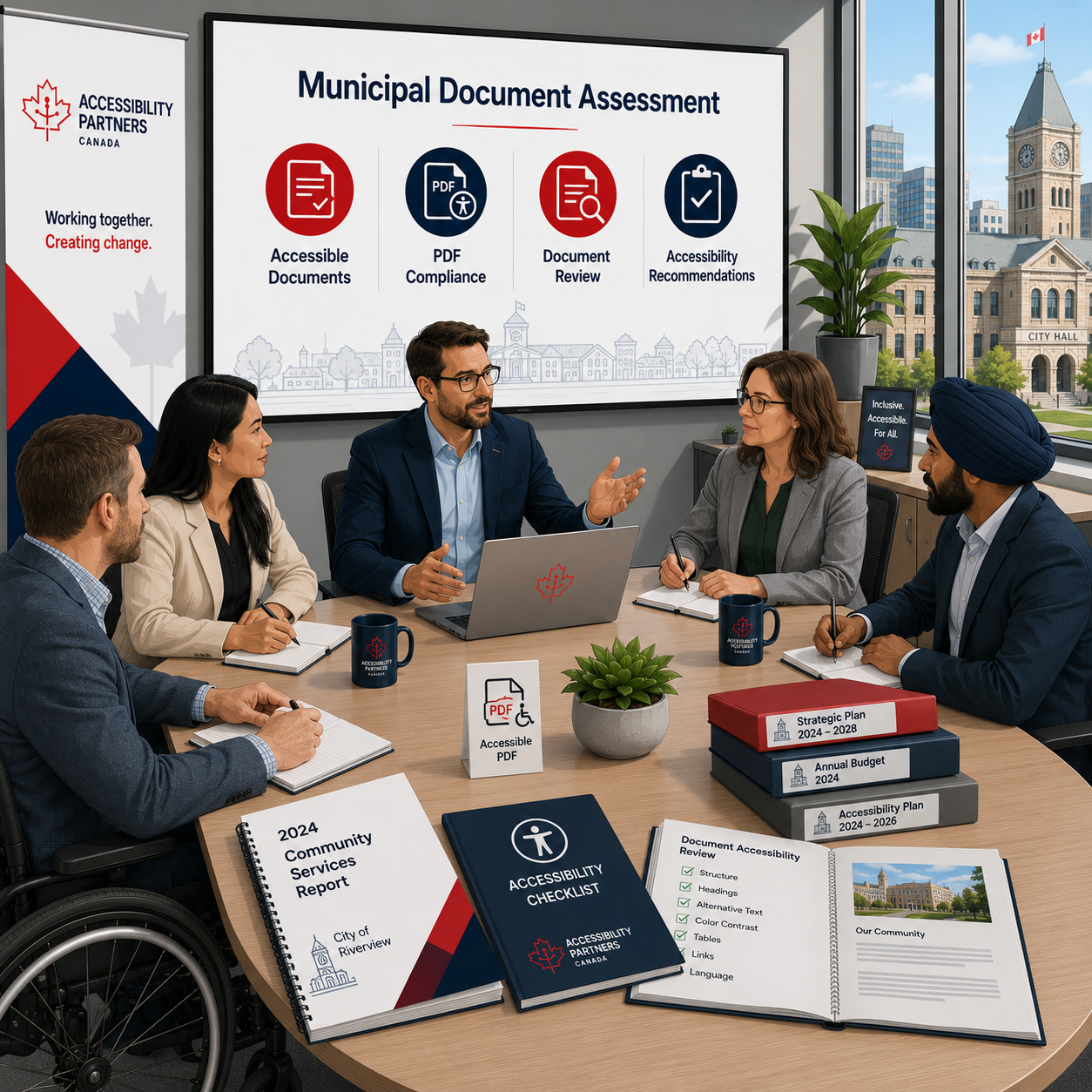
A large Ontario municipality engaged Accessibility Partners to assess the accessibility of its public-facing PDF documents and to understand why non-conformance was occurring — not just to document it. The result was both a document-level remediation plan and an organisational strategy to prevent the same problems from recurring.
The Document Conformance & Workflow Challenge
Municipalities publish hundreds of documents annually, produced by staff across dozens of departments. Accessibility awareness, authoring tools, and workflows vary widely. The municipality suspected significant non-conformance but did not know the extent, the root causes, or where to begin.
Our Document Audit & Strategy Approach
We audited 48 representative documents against AODA and PDF/UA standards. Simultaneously, we surveyed the 117 staff members responsible for creating those documents — achieving an 85.7% response rate. The survey covered authoring tools, workflow practices, training levels, and accessibility awareness.
Combining the audit findings with the survey data allowed us to identify not just which documents failed, but why and to build a remediation strategy that addressed the underlying organisational causes rather than simply fixing 48 individual PDFs.
Project Snapshot
Industry
Municipal Government
Location
Ontario, Canada
Compliance Standard
AODA
AODA Document Assessment Results
Services Used


Legislation: AODA
Talk to Us About Document Accessibility Strategy
Every engagement we take on is led by a credentialed senior consultant — not delegated to junior staff after the proposal is signed. We hold Government of Canada Standing Offer #1 national ranking, $5M errors and omissions insurance, and twelve years of experience across federal, provincial, municipal, and private-sector clients.
If your organisation suspects a systemic document accessibility problem and needs both the diagnosis and the fix, we would welcome the conversation.
Frequently Asked Questions
+
What is the difference between a document accessibility audit and a document remediation strategy?
An audit identifies accessibility problems, while a remediation strategy focuses on fixing root causes and preventing future issues.
+
How do you identify the root causes of document non-conformance across an organisation?
We review workflows, tools, templates, staff training, and document creation practices.
+
What does an AODA and PDF/UA document audit actually check?
It checks headings, tags, reading order, alt text, tables, links, colour contrast, and screen reader compatibility.
+
How do you prevent the same accessibility problems from recurring after remediation?
Organizations can improve templates, workflows, staff training, and quality assurance processes.