WCAG 2.2 Audits for Four Major Canadian International Airports
One airport rebuilt its entire website based on our audit findings. When we re-audited 20 months later, total accessibility issues had dropped from 199 to 94 \- a 53% reduction. Conformance score nearly doubled, rising from 27.50% to 54.76%.
Project Overview
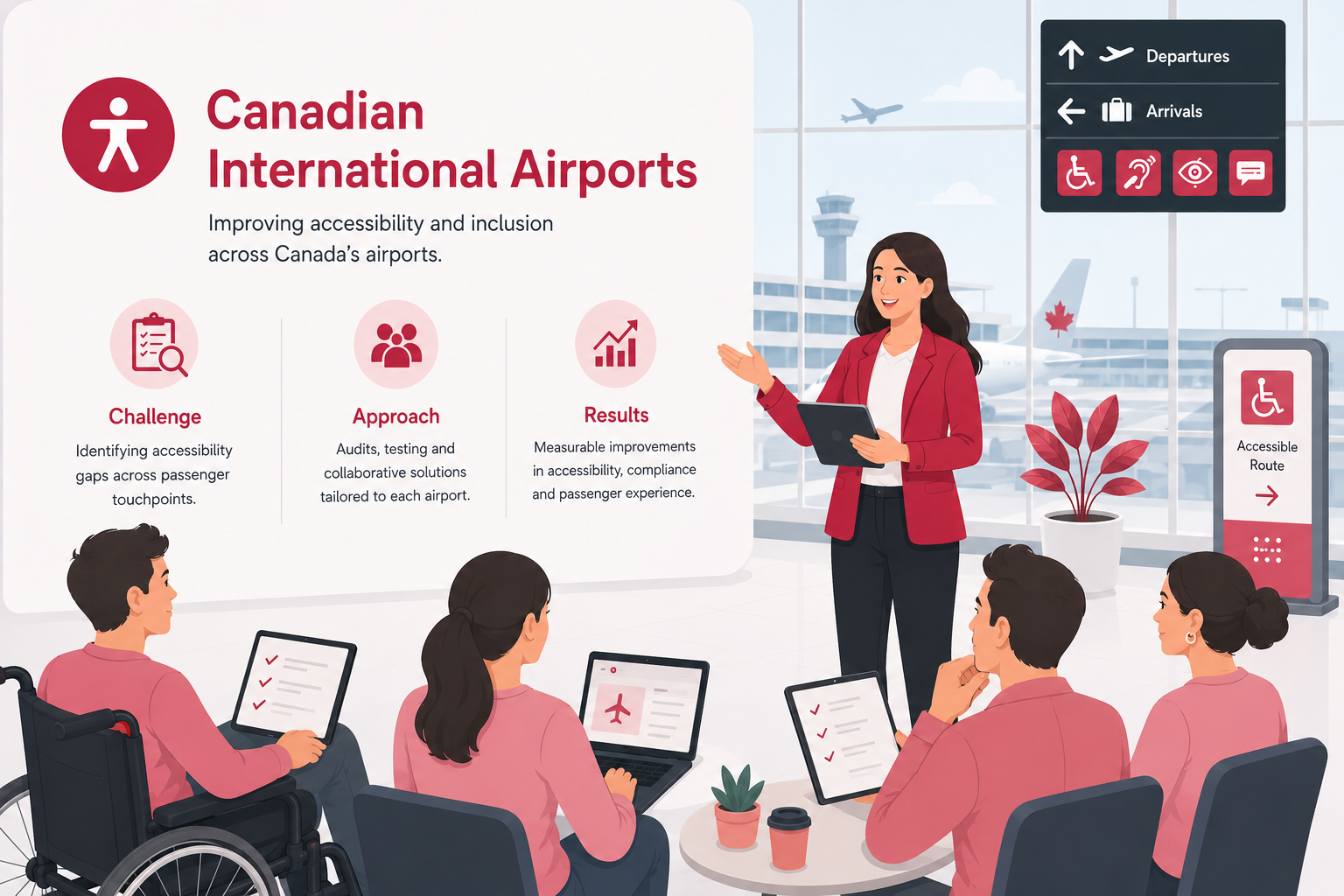
Accessibility Partners has conducted WCAG 2.2 Level AA audits for four major Canadian international airports. Airport websites are not discretionary digital products. Travellers with disabilities rely on them for gate information, accessibility services, parking, ground transportation, and terminal navigation. When those pages fail, the barrier begins before the passenger reaches the building.
Under the Accessible Canada Act and the Accessible Transportation for Persons with Disabilities Regulations (ATPDR), federally regulated transportation providers are required to identify, remove, and prevent accessibility barriers in their operations and services. Our airport engagements span initial conformance audits, remediation advisory, and re-audit verification. In our most documented engagement, our findings drove a complete website rebuild and we returned to measure the outcome.
The Conformance Challenge
Each airport came to us at a different point in its accessibility journey. Some needed a clear conformance baseline before committing to a remediation program. Others had already begun remediation and needed independent verification of their progress. All required testing that went beyond automated scanning – covering keyboard navigation, screen reader compatibility, colour contrast, form labelling, and the specific user flows a traveller with a disability depends on most.
For airports, the stakes are operational. A passenger who cannot access gate change information, request wheelchair assistance, or find accessible parking has encountered a barrier before reaching the terminal.
Our WCAG 2.2 Audit Approach
For each engagement, we tested against WCAG 2.2 Level AA across a representative sample of pages, prioritising high-traffic templates and critical user journeys. Testing combined automated tools with manual evaluation using NVDA, keyboard-only navigation, and colour contrast analysis. Each airport received a detailed audit report mapping every issue to its WCAG success criterion, with remediation guidance prioritised by impact and effort.
In our most documented engagement, we audited 62 pages in March–April 2024. The airport commissioned a full website rebuild based on our findings. In December 2025, we returned and re-audited the new site across 55 pages.
Project Snapshot
Location
Canada
Compliance Standard
Accessible Canada Act | ATPDR
Key Result
53% issue reduction · Score nearly doubled
Before and after - one airport engagement.
Before (Apr 2024)
- Conformance score
- 27.50%
- Total issues
- 199
- Pages tested
- 62
After (Dec 2025)
- Conformance score
- 54.76%
- +27.26 points
- Total issues
- 94
- 53% reduction
- Pages tested
- 55 (rebuilt site)
- Full rebuild
Across all four airport engagements:
Services Used


Talk to Us About Your Compliance Program
Frequently Asked Questions
+
Do airport websites need to meet WCAG 2.2 or is WCAG 2.1 still acceptable?
Many airports still follow WCAG 2.1 AA, but WCAG 2.2 provides stronger accessibility coverage and is becoming the preferred standard for transportation websites.
+
How many pages do you typically audit in an airport website engagement?
The number depends on the size of the website, but audits usually focus on key templates, high-traffic pages, and important traveller journeys.
+
What is the difference between automated scanning and manual screen reader testing?
Automated tools find technical issues, while manual testing checks whether real users can successfully navigate and use the website with assistive technology.
+
How long does a re-audit take after a full website rebuild?
Most re-audits are completed within a few weeks, depending on the size and complexity of the rebuilt website.